St. John's
Sermon - Jun 01, 2026 The Beginning
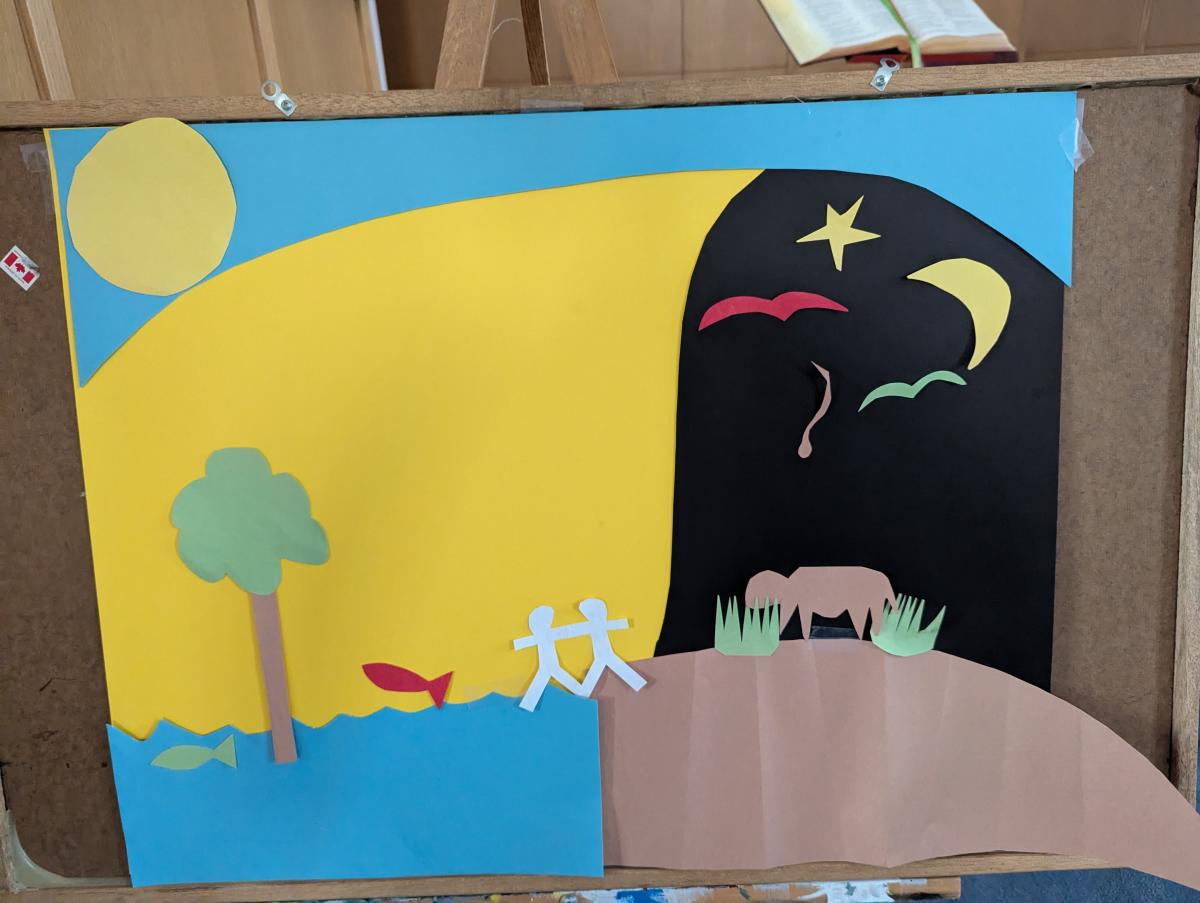
The Beginning
The Beginning: Trinity Sunday, May 31, 2026
Genesis 1:1-2:3, Matthew 28:16-20
Rev. Heather Carlson, St. John’s Presbyterian, Medicine Hat, AB
Book to read over the summer? Enjoying devotions on the first five books of the Bible - Bible project through YouVersion. Revisiting the stories with what I know and have experienced, and how the world is now. The Spirit speaks through the words - just as Jesus promised to be always with us. And they are epic stories of faith and doubt - like the disciples in Matthew’s gospel - worship and doubt - clarity and questions. As we seek to respond to the goodness of the God of heaven and earth.
So we’ll go through Genesis until June 21 - move downstairs and I’m on vacation, so we’ll enjoy the leadership of others. Return mid July and pick up the last 4 books, and Bible study.
These are the scriptures of the Hebrew people - the Torah, and they begin our Christian Bible. So we start at the beginning.
“May the Lord bless you and protect you. May the Lord smile on you and be gracious to you. May the Lord show you his favor and give you his peace.”
Those ancient words from Numbers are the oldest physical fragment of the Old Testament ever discovered. In 1979, archaeologists in Jerusalem uncovered tiny slivers of silver, carefully rolled up, likely worn by someone close to the body as a blessing and prayer. Those words were already ancient 2,676 years ago. Human beings have always longed to know that they are held by grace, protected by mercy, and remembered by God.
And even older than those silver scrolls is the ancient poetry embedded in Scripture itself. Most scholars believe the Song of the Sea in Book of Exodus 15 is among the oldest oral traditions in the Bible, perhaps sung some 3,300 years ago:
“I will sing to the Lord, for he has triumphed gloriously.”
Long before texts were gathered into books, before chapters and verses, before scrolls were copied by scribes, the people of God sang. Faith was carried in memory, in poetry, in worship. The people remembered who God was by telling the story again and again.
And yet when Israel’s writings were finally arranged, the Bible does not begin with Exodus or with Abraham or Moses. It begins with Genesis. The word Genesis means “beginning,” “origin,” or “creation.” The patchwork tapestry of stories that orient us with these words:
“In the beginning God…”
Walter Brueggemann writes that from the very beginning Israel bears witness to a “[God]-dominated truth.” Scripture invites us into a story fundamentally opposed to any understanding of the world that imagines creation apart from God. The universe is not self-generated, self-sustaining, or self-explaining. It belongs to God.
And this placement matters. Israel’s story begins not merely with Israel itself, but with all creation. God’s covenant purposes are universal in scope. Before there is a chosen people, there is a created world loved into existence by God.
In Genesis the opening eleven chapters gather ancient sagas and sacred memory. Then the focus narrows into the family narratives of Abraham, Isaac, Jacob, and Joseph. Throughout it all we see divine action and human response intertwined.
The narratives become, as one commentator says, “a vehicle through which each new generation can learn its identity once again as the people of Abraham.” The stories remind God’s people where they have been, who they are now, and what kind of future God is calling them toward. Again and again, God works through flawed people in a broken world in order to move creation toward God’s purposes. This is good news for us, because Scripture never waits for perfect people before beginning God’s work.
Now Genesis is not a modern scientific document, but neither is it unconcerned with the material world. Old Testament scholar Terence Fretheim notes that Israel’s theologians showed deep interest in the ordering of creation: the classification of plants, the creatures of sea and sky, the rhythm of days, the structure of life itself. The text is asking “Who created?” and “Why?” and also reflecting carefully upon the “how” of creation as ancient people understood it.
Its descriptions are not congruent with current scientific knowledge, but Genesis continues to invite every generation into the task of integrating all knowledge into a coherent vision of creation under God. And to do so as those who are creatures - humble, made from the earth, encountering a world and a God who has worked marvelous wonders.
And throughout the chapter, God remains the primary subject. Every movement of creation relates back to God. Light, land, creatures, stars, seas — all exist in relationship to the Creator.
Genesis takes God’s existence for granted. God’s eternal power and divine nature are assumed from the first verse. Scripture does not speculate about what God was doing before creation. And the text is not preoccupied with where the raw materials came from. Instead, it bears witness to what God has done and continues to do.
And who this God is unfolds gradually through story. By the end of Genesis 1 we know something of God’s majesty and creativity. By the end of Genesis as a whole we know far more: a God who calls, promises, grieves, judges, forgives, accompanies, and remains faithful.
If you pick up and read the subsequent chapters, you’ll see that in chapter 2 creation starts all over again. The two creation stories of Genesis complement one another beautifully.
One commentator noted that it’s almost like two different ways of cooking. Some cooking begins with a recipe: measured ingredients, careful timing, ordered steps. The other begins by opening the refrigerator, chopping what is available, tasting as you go, improvising creatively along the way.
Genesis 1 is orderly, rhythmic, majestic: “and there was evening and morning…” God speaks and creation unfolds with symmetry and structure. Genesis 2 feels earthy and immediate. God kneels in the soil, forms humanity from dust, plants a garden, walks in its midst. The God of Scripture is both transcendent and intimate, sovereign and near. Its focus is the transformation from chaos into cosmos, from emptiness into life.
Scholars posit that Genesis was likely written and compiled some 2700 years ago when the Hebrew people were captive in Babylon. Away from the structures of Temple and King. Afraid for the future and unsure if God had abandoned them. For Israel in exile, these words carried immense hope. Their lives had become “formless void,” enveloped in darkness and uncertainty. But Genesis declares that God is still the One who brings light into darkness and order into chaos.
That hope remains for us today. We know what it feels like to inhabit a kind of inner wilderness — grief, confusion, fear, loneliness, despair. Or to encounter the deep darkness of a world of chaos. Genesis reminds us that no darkness is beyond the reach of God’s creative Spirit.
“And a wind from God swept over the face of the waters.” The Hebrew word there can also mean breath or Spirit. Breath is essential to life, and life comes from God. The Spirit hovers over chaos preparing creation for life. Light, stars, oceans, birds, creatures, vegetation — these are not merely resources for human consumption. Creation has status and honour because God has fashioned it and delights in it.
In fact our opening story is 5/6ths complete before humans arrive. We are not masters standing over creation. We are creatures within it, called to stewardship and care.
Mother Teresa once said her calling was “to do something beautiful for God.” In many ways that is the calling of creation itself. God creates something beautiful, and we are invited to participate in that beauty with lives shaped by love, mercy, justice, and praise.
Ancient peoples of the Mediterranean region often imagined their gods through carved images — visible statues and idols of wood, stone, or metal. But Genesis makes a radical claim: Humanity itself is made in the image of God.
We are encountering a God who is personal, not merely an abstract force or distant principle. And it also means that every human being bears dignity, worth, and sacred responsibility. To be made in God’s image is to reflect something of God’s character into the world.
And this brings us to the risen Christ in Gospel of Matthew 28. After resurrection, Jesus gathers the disciples on a mountain in Galilee and sends them into the world:
“Go therefore and make disciples of all nations, baptizing them in the name of the Father and of the Son and of the Holy Spirit.”
The God who says, “Let there be light,” is the same God revealed to us as Father, Son, and Holy Spirit.
The Trinity is not an abstract puzzle for theologians to solve. It is the living reality of God’s relationship with the world from beginning to end. Creation itself bears the fingerprints of the triune God: the Father speaking, the Word bringing forth life, and the Spirit hovering over the waters.
And notice the scope of Christ’s commission: “all nations.” Just as Genesis begins with the whole creation before narrowing to Israel, the gospel now widens again outward to all peoples and all creation. The same God who brought order out of chaos now sends the church into a fractured world bearing the promise of reconciliation and new creation.
And Jesus ends with a promise that echoes all the way back to Genesis:
“And remember, I am with you always, to the end of the age.”
The God who was present at the beginning remains present still.
The Spirit still hovers over troubled waters.
The Son still calls disciples forward.
The Father still blesses creation with grace and peace.

World Communion Sunday
Posted On Oct 06 2026